The Capacity Breakthrough: 4 Levers to Break the Manager Squeeze
In moments of vulnerability, managers I’ve worked with have shared invisible stressors they navigate daily. They’re tackling large workloads, balancing the needs of their teams and senior leaders, while seemingly keeping everything together.
When I talk to the people around them, another narrative emerges. Their teams and leaders can sense their stress; it’s palpable. The need to balance everything can show up as either micromanaging or overly hands-off; they may even come off as cold or disconnected, even when the intention is to lead with support and authenticity.
Why the disconnect?
Gallup research confirms that as organizations flatten their structures to cut costs and increase speed, the "Great Flattening" has led managers to oversee significantly larger teams than they did a decade ago. Recent data indicate that the average number of reports has jumped 50% since 2013, with some leaders managing teams of 25 or more. (Gallup)
When you combine ballooning teams with the pressure to adopt new AI tools and navigate hybrid or return-to-work complexities, it’s clear why middle managers report the lowest levels of psychological safety. They’re wedged between the high expectations of senior leadership and the burnout of the front line.
This tension is the hallmark of the "squeezed middle." When managers are stretched too thin, decision-making stalls and talent begins to leak. This fundamental risk affects the entire organization's operations.
To move forward, we should stop asking these leaders to simply "do more" and start looking at how we can expand their actual capacity.
Capacity Lever 1: Vulnerability as a Performance Strategy
One of the most effective (and underused) tools for expanding capacity is encouraging vulnerability. We often treat managers as if their capacity is infinite, but pretending to be unaffected by workplace demands creates a culture of guesswork or rogue behavior, often leading to "Shadow AI", use of unvetted tools as a survival mechanism, or cutting corners in other risky ways.
When a manager is honest about their limits, it builds the trust needed for a team to co-design solutions ethically and pivot effectively. In our talent management coaching work, we see that teams led by transparent, vulnerable leaders are more resilient because they spend less energy navigating their managers' stress or guessing what’s on their minds, and more energy solving business problems.
In one of our recent executive team sessions, the CEO shared with his leadership group that the pressures from the Board to do more with less and to shrink his own team were weighing heavily on his day-to-day decision-making. He knew he needed to address the Board’s concerns, but was struggling to come up with the best outcomes for a team he’s led for years. That show of vulnerability gave other leaders in the room a view into executive choices that had previously felt opaque or arbitrary. It also opened up a new discussion: how they could collectively support their leader in influencing the impending restructure.
Capacity Lever 2: Identifying "Shadow Work"
If we want to reclaim time, we can start by identifying where it’s being wasted. Most managers are bogged down by "shadow work," the administrative friction and meetings that don't move the needle. Research shows that managers are most effective when they spend no more than 40% of their time on individual contributor tasks, leaving the majority of their time to people management. (Gallup)
We recommend completing a "Shadow Audit." Look at the recurring tasks that drain the team's energy. Are there bottlenecks that can be automated? Are there status meetings that could be replaced by a tech stack designed for asynchronous updates? This audit is also the first step in identifying where "Shadow AI" (or any other risky or ineffective practice) is building, allowing you to bring those workflows into a governed, equitable framework. Reclaiming even a few hours a week from these practices allows a manager to shift back into the high-value coaching their team actually needs.
Capacity Lever 3: Implementing Decision Rights
Capacity is often drained by "decision lag." When managers have to "manage up" for every minor approval, or when direct reports are unclear on what they own, work stalls. By defining who owns what in fast-moving environments, you reduce the emotional and operational load on the middle manager who no longer has to be the bottleneck. This helps to build a culture where people at all levels have the defined expectations, skills, and support to succeed.
Capacity Lever 4: Protecting the "Top Rocks"
There will always be more tasks than time. To protect your team's output, pause low-value work. We use a "Value vs. Effort" matrix to help our clients identify their "top rocks," the initiatives that truly drive value.
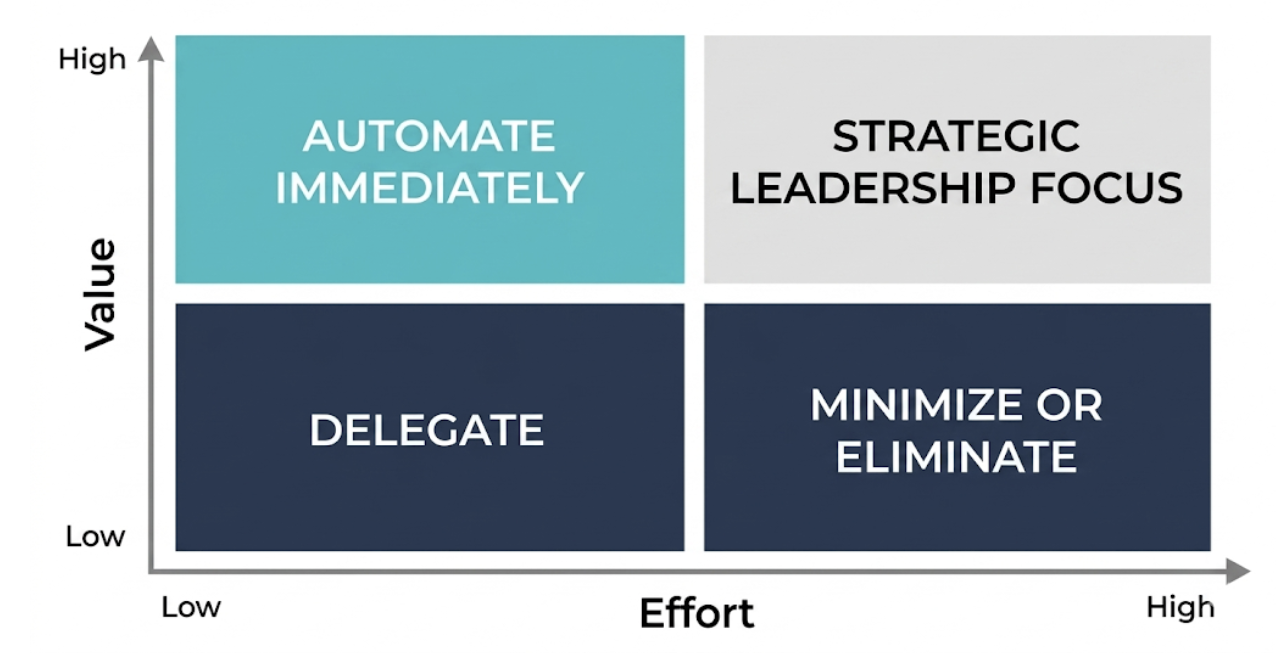
Additionally, executive coaching programs are designed to give leaders the courage to make these trade-offs explicit. When senior leadership is clear about those priorities that are non-negotiable, they give their middle managers the "air cover" they need to protect their teams from burnout.
Investing in the Middle
Beyond a one-time event, expanding manager capacity should be a continuous investment. Whether through leadership and executive coaching or specialized workshops like our Manager Capacity Suite, the goal is to move managers from "surviving the middle" to leading with human-centric oversight in an increasingly automated environment.
When the middle is strong, performance compounds and culture stabilizes.
Ready to find your team's hidden capacity? Start by picking one process this week and running a 'Shadow Audit.' Ask your team: 'Which part of our current workflow was built for a version of this organization that no longer exists?’ Use that reclaimed time for deep work, and let us know what you discover.